
Help24
Live · Côte d'Ivoire
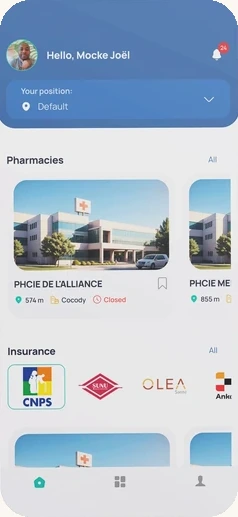
Pharmacies and riders on one side, patients on the other. Prescriptions, a wallet, an on-duty pharmacy filter by location, and a PIN-protected medical file vault.
Marketplaces · Healthcare and pharmacy
A pharmacy marketplace connects patients with nearby pharmacies and the riders who bring the medicine. It is for you if your providers are pharmacies and some orders need a prescription checked first. We built Help24, live in Côte d'Ivoire, so we know where it differs from a delivery app.
The problem
A pharmacy marketplace has three sides, not two, and one of them holds a professional licence. The patient wants medicine now. The pharmacist must check the prescription first. The rider must hand the order to the right person. Every step a food app can skip, this one has to record.
Not healthcare and pharmacy? See marketplace app development in general
In a generic marketplace, the provider app is a list of jobs to accept. A pharmacy panel does more. The pharmacist decides whether an order can go ahead at all, and that decision depends on a document the patient uploads, not on what is in the basket. So the panel opens on prescriptions waiting for review, not on orders waiting for a rider.
The patient side changes too. People often order medicine for someone else: a child, a parent, a partner who is too ill to do it. A prescription in one name attached to an account in another is normal here, not a sign of fraud. We ask whether patients can keep profiles for family members, so each prescription and file sits with the right person and the pharmacist sees whose medicine it is.
A food order is placed, prepared and brought to the door. A prescription order has another state before any of that: submitted and waiting for review. While it waits, the patient needs to see that someone is looking at it, the payment must not be treated as final, and no rider should be assigned. When the pharmacist rejects it, the patient needs a reason and their money back, without anyone sending an email.
Then there is the handover. A rider collecting a sealed bag from a pharmacy and handing it to a patient creates two moments that may need proof: that the right pharmacy released it, and that the right person received it. We ask what your operators need recorded at each moment, such as a time, a code the patient reads out, or a photo, and build that record into the rider app and the console.
In a two-sided marketplace, the provider usually sees the customer's name, address and order. In a pharmacy marketplace, each side should see less. The pharmacist needs the prescription attached to this order, not the patient's whole file. The rider needs an address and a handover check, not the prescription. Your console team needs enough to resolve a complaint, and no more.
That is why Help24 keeps medical files in a PIN-protected vault. For your platform we write the view for each role down in phase one, before screens are designed, because adding a restriction after launch means changing every screen that already shows the data. Help24's Flutter mobile and Flutter Web apps share most of the business logic, so a rule about who sees what is written once and holds on both.
On top of our five standard questions, a pharmacy build adds three. Who reviews prescriptions, and what do they need to see to decide? Does a handover need proof, and what kind? Who holds the patient's money while a prescription waits? The answers change the pharmacy panel, the rider app and the payment flow, so we settle them in scope rather than discover them in the build.
| Pharmacy panel | Replaces the generic provider app: on-duty status, item availability, prescriptions waiting for review, and orders to prepare. |
|---|---|
| Prescription upload and review | The patient uploads a prescription; a pharmacist accepts it, rejects it with a reason, or asks a question before the order goes ahead. |
| Rider app | A third side the generic build does not have: collect from the pharmacy, confirm handover to the patient, with a time on each step. |
| Medical file vault | Patients keep prescriptions and medical files behind a PIN, separate from order history and hidden from riders. |
| On-duty pharmacy search | Search by location that can be limited to pharmacies open and on duty now, with the status set by the pharmacy or your team. |
| Payment held during review | Payment is not final while a prescription is under review. It is charged on acceptance or returned to the patient's wallet on rejection. |
| Doctor and hospital readiness | Data shaped so doctors and hospitals can join in a later phase without a rebuild. |
Everything else is the standard build — see what's included.
What makes this one hard
The order is not an order until a pharmacist says yes.
In most marketplaces the customer pays and the provider fulfils. Here a prescription order sits between the two, waiting for review. Every screen, payment and notification has to know what to do while it waits, and what to do when the answer is no.
Live · Côte d'Ivoire
Pharmacies and riders on one side, patients on the other. Prescriptions, a wallet, an on-duty pharmacy filter by location, and a PIN-protected medical file vault.
Live · operated by us
Ours. Where we learned to build refunds, disputes and payouts as flows in phase one, not as emails after launch.
How is a pharmacy marketplace different from a food delivery app?
It adds a decision before the order can go ahead, and a professional who makes it. A food app takes payment and sends a rider. A pharmacy marketplace may need a pharmacist to review a prescription first, so the order waits in a state food apps never have. It also adds a handover to the patient that may need recording. The components look similar; the order flow does not.
What happens to the payment if a pharmacist rejects a prescription?
The patient gets their money back without contacting anyone. We build the payment so it is not treated as final while a prescription is under review, then charged when the pharmacist accepts or returned when they reject. With a wallet, as Help24 has, the money goes back to the patient's balance. The patient sees the pharmacist's reason in the app, and the console keeps the decision, the reason and the refund on one record.
Read the full guideWhat does the rider see about a patient's order?
Only what they need to collect it and hand it over. Usually that is the pharmacy, the patient's address, a way to make contact, and a handover check. The rider does not need the prescription or the patient's medical files, so the rider app does not show them. We ask what your operators want recorded at handover, such as a code or a photo, and whether some orders need the patient's identity checked at the door.
Can patients use the platform on the web as well as the app?
Yes. Help24 runs on Flutter mobile and Flutter Web, sharing most of the business logic, so a rule about prescriptions or on-duty status is written once and behaves the same on both. That matters for patients ordering from a computer on behalf of a relative, and for pharmacy staff working from a computer at the counter. We ask which sides need the web at launch and which can wait for a later phase.
How does a pharmacy show that it is on duty?
Through a status that search reads. Help24 lets patients filter for pharmacies on duty near them, so at night they see only the ones that are open. The hard part is keeping that status true. We ask whether each pharmacy sets it in their panel or your team sets it from a rota in the console, and what the patient app shows when no pharmacy nearby is on duty.
Can we take commission from pharmacies?
The platform can support it. Commission can be a percentage, a fixed fee or set per category, and it is changed in the console, not in code. Whether you may take commission on medicine, or should charge a delivery fee instead, is a question for your adviser and depends on local rules. We build whichever model you settle on, and we ask in scope, because it changes the receipts pharmacies and patients see.
No call. A few guided questions, then a tailored quote — usually within one business day.
Or send us the idea in three sentences on WhatsApp, or email support@codingwitht.com.